
Cold Weather Evacuations
Mastering Cold Weather Evacuations: Insights, Challenges, and Proven Techniques
If you haven't had the chance to read the Review of Vacuum for Service Engineers, it's well worth your time. While it's a technical and detailed resource, it provides invaluable insights into the most common challenges of completing a proper evacuation. With the recent cold spell, I thought it would be helpful to share some key data from the book along with practical advice for tackling cold-weather evacuations.
Evacuating an HVAC system during the winter presents unique challenges that many technicians underestimate. Cold temperatures slow molecular activity, reduce vacuum pump performance, and make moisture removal exponentially more difficult. As outlined in "Review of Vacuum for Service Engineers", moisture, molecular behavior, and pump performance all change when temperatures drop, requiring technicians to adjust their approach.
In this article, we'll explore the science behind cold-weather evacuation, the challenges involved, and practical techniques, like running the furnace during evacuation, to ensure a proper vacuum. We'll also highlight how tools like "TruBlu hoses" and the "AccuTools BluVac Professional" with its patented "Leak Rate Indicator" simplify the process.
1. Why Cold Weather Makes Evacuation Harder
Molecular Behavior Slows Down
Molecules move slower at lower temperatures (pp. 19-21). Since water vapor relies on molecular energy to escape surfaces, cold conditions trap moisture in tubing and components. When the temperature drops, the vapor pressure of water decreases, making it harder for the vacuum pump to boil moisture off.
Water Vapor Sublimation Complicates the Process
Moisture can freeze within the tubing, transforming into ice and requiring sublimation (p. 27). Sublimation occurs when ice turns directly into vapor, but this process takes far longer at low temperatures, adding hours to the evacuation if not addressed.
2. The Vacuum Pump's Struggle in Cold Weather
Cold Oil and Water Liberation
Vacuum pumps rely on clean, warm oil to trap and remove water vapor (p. 76). In cold weather, oil thickens and becomes less efficient at releasing the moisture it traps. Additionally, cold oil doesn't circulate as easily, increasing the risk of vapor lock. If there is residual moisture in the pump it can freeze the vanes in place making it impossible to start the pump.
Pump Startup Issues
When the oil thickens, vacuum pumps may fail to start or may operate inefficiently. In extreme cases, the pump may run without achieving the necessary deep vacuum due to oil viscosity impeding proper sealing (p. 77).
3. Protecting Tubing During Installation: Cold-Weather Best Practices
The "Review of Vacuum for Service Engineers" stresses the importance of keeping tubing dry (p. 69):
- Seal Open Tubing Immediately: Moisture-laden air rapidly condenses inside cold pipes. Cap or tape all open lines during installation.
- Store Materials Indoors: Keep tubing and other components at room temperature whenever possible.
- Avoid "Snow Exposure": Tubing exposed to snow or ice can trap moisture that takes significantly longer to evacuate.
4. Strategies to Speed Up Evacuation in Cold Weather
- Run the Furnace During Evacuation (p. 67)
Running the furnace during evacuation adds heat to the refrigerant circuit, increasing molecular energy and water vapor pressure. This simple technique can dramatically reduce evacuation time. - Use the Right Hoses: TruBlu Vacuum Hoses (p. 61)
The handbook emphasizes the importance of conductance speed in vacuum performance. "TruBlu hoses", with their 3/4" diameter and vacuum-rated design, provide optimal conductance for winter evacuations. - Monitor the System with the BluVac Professional's Leak Rate Indicator (p. 103)
The AccuTools BluVac Professional streamlines the process with its Leak Rate Indicator, which quantifies the rate of pressure change to help technicians distinguish between moisture and leaks.
5. Troubleshooting Cold Weather Evacuation Issues
- Vacuum pump won't start: Warm the pump and use a cold-weather vacuum oil.
- Vacuum stalls and won't drop below 500 microns: Moisture likely remains; run the furnace to add heat.
- Rapid micron rise during the decay test: Likely a leak; use the BluVac Professional Leak Rate Indicator to quantify the rise. As we discussed in our article on identifying true leaks in a vacuum, distinguishing between moisture and actual leaks is critical for proper diagnosis.
6. Breaking Free from Weather Constraints
Just like our approach to cold weather commissioning, proper evacuation shouldn't be limited by outdoor temperatures. The AccuTools Low Temperature Charging Solution, integrated with measureQuick, allows technicians to create controlled environments around condensers, enabling proper evacuation and commissioning even in frigid conditions. This technology extends your service window dramatically, allowing you to maintain consistent quality year-round.
7. Ideal Evacuation Targets for Heat Pumps
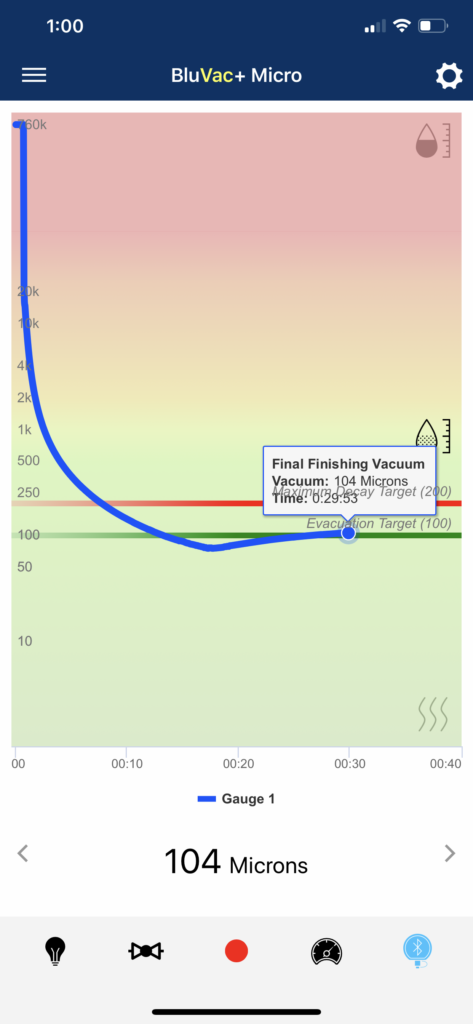
For heat pump systems, achieving the correct evacuation target is even more critical due to the potential for moisture freezing in the outdoor coil and the increased refrigerant volume. According to the Review of Vacuum for Service Engineers (pp. 88-90), the following targets should be adhered to:
- Target Vacuum: 100 microns or less ensures proper moisture removal and system cleanliness.
- Acceptable Decay: No more than 200 microns after isolation during a decay test.
- Decay Rate: A pressure rise of no more than 1 micron per minute is ideal, indicating that moisture and non-condensables have been sufficiently removed.
These parameters ensure that the system remains free of harmful contaminants and operates at peak efficiency. Exceeding these thresholds typically indicates remaining moisture or a potential leak, requiring re-evacuation or leak detection procedures.
Watch That Decay Rate!
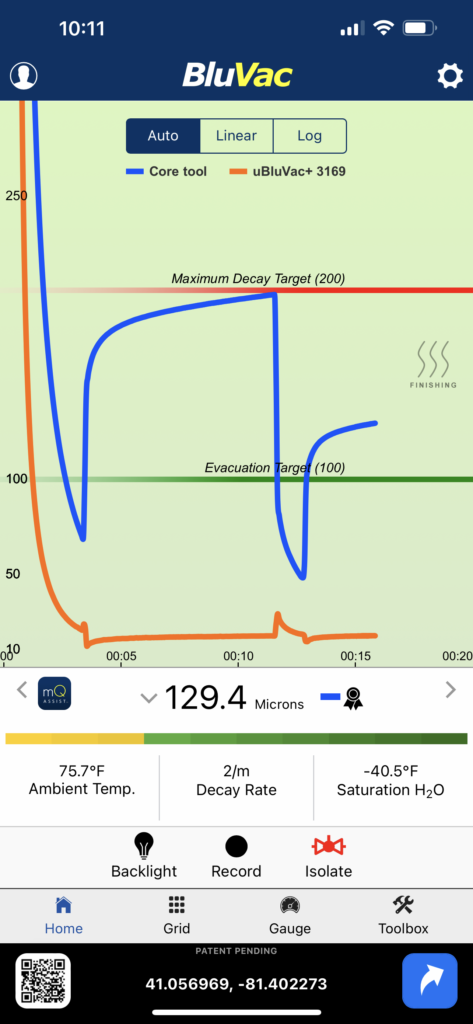
Take this example: Although the system hit 100 µm, the decay test tells a different story. The system is still wet as indicated by the rise and tail off of the gauge installed on the core tool. Multiple gauges can be helpful to understand what is happening at the pump as well as on the far side of the system.
Final Thoughts
The science behind cold-weather evacuations is well-established, yet many technicians still struggle with moisture issues in winter. By following the principles laid out in Review of Vacuum for Service Engineers, and incorporating modern tools like TruBlu hoses and the AccuTools BluVac Professional with measureQuick, technicians can dramatically reduce evacuation time and improve system reliability.
Key Takeaways:
- Moisture is more stubborn in cold weather due to slower molecular activity. (pp. 19-21)
- Vacuum pump performance suffers due to oil thickening and molecular dynamics. (p. 76)
- Running the furnace during evacuation adds heat, increasing water vapor pressure. (p. 67)
- TruBlu hoses and the BluVac Professional Leak Rate Indicator simplify and accelerate evacuation. (pp. 61 & 103)
- The AccuTools Low Temperature Charging Solution, integrated with measureQuick, removes seasonal limitations on proper charging procedures.
Winter evacuations are harder, but with the right knowledge, tools, and measureQuick's smart diagnostics, they're also completely manageable.
When working with heat pump systems, adhering to the 100-micron evacuation target, with a decay not exceeding 200 microns and a decay rate below 1 micron per minute, ensures long-term system reliability and efficiency. These parameters, established through field data and vacuum science (pp. 88-90), offer technicians a clear benchmark for successful evacuation, regardless of outdoor temperature.
Reference: Review of Vacuum for Service Engineers, pp. 88-90.