
A vital sign for the whole system.
A doctor does not guess your health from how you look. They take vitals. HVAC Vitals™ does the same for a system: one 0 to 100 score, built from real measurements, that tells you whether the equipment is doing its job.
What residential commissioning means
Commissioning is the practice of verifying that a system performs the way it was designed to, before you call the job done. In commercial construction it has been standard for decades. In residential HVAC it mostly has not, and the data shows the cost.
The U.S. Department of Energy finds only about 38% of field systems carry a correct charge. In measureQuick's field diagnostic data, 45.4% of cooling systems fail charge verification and 70%+ run past 0.5" static pressure. Both rob capacity, raise bills, and shorten equipment life. The homeowner never knows. The contractor finds out as a callback.
A system has its own vital signs, and no single one tells the whole story. Refrigerant charge, read against the live conditions the system is running in. Static pressure, the system's blood pressure. Airflow across the indoor coil. Delivered capacity against what the nameplate promised. A system can blow cold air and still be failing on any one of them, and the only honest way to know is to measure them all and grade them against a published standard.
Residential commissioning closes that gap. Measure the system, compare it against a standard, document the result. measureQuick makes that practical on every service call, and HVAC Vitals™ is how it reports the answer.
One number, honestly earned
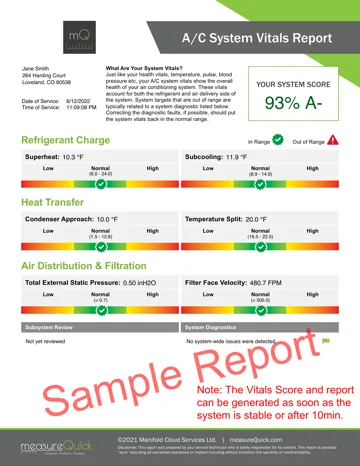
Vitals rolls the refrigerant side, the air side, and the system conditions into a single 0 to 100 score. A pass is a system you can stand behind. A fail tells you exactly which measurement pulled it down.
The bands read like a report card: 90 to 100 is a properly commissioned system, 70 to 89 is marginal, below 70 has multiple issues. And the grade cannot be pencil-whipped. A meaningful score only appears when all nine probes are connected and reading live. The grade comes from measurement.
On the homeowner's copy the number carries a letter grade, because a grade needs no translation. Paul McHugh, a sales manager and trainer at Ray O. Cook, puts it plainly: "with a letter grade, everybody went to school and everybody knows A is good and D and F is bad." Letter grades use the standard scale everywhere: 90 A, 80 B, 70 C, 60 D.
The score is age-adjusted. A fifteen-year-old system is graded against what it can reasonably do today, adjusted for its age. The number stays fair and the homeowner stays trusting.
On gas heat, since the October update, CO air-free no longer lowers the heating Vitals score. It shows as a four-level condition indicator, and dangerous CO still fails the test. A combustion stability indicator shows when readings have settled, and multi-cell furnaces are supported on the combustion page.
A nine-probe picture of the system
A complete read takes measurements at the points that actually determine performance: supply and return air, suction and liquid conditions, and the indoor and outdoor environment. Vitals is built from that full picture across every channel. Skip a channel and the system cannot honestly grade itself, which is the design intent.
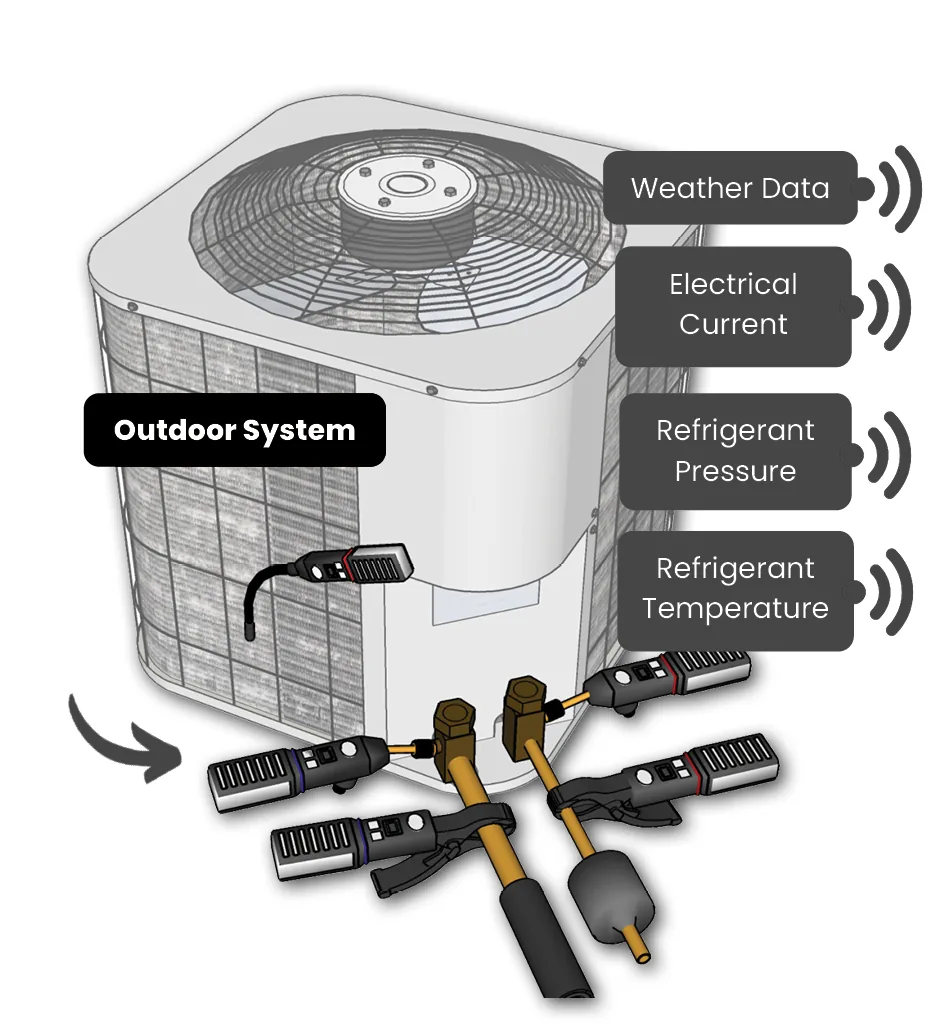
Normalized to rated conditions
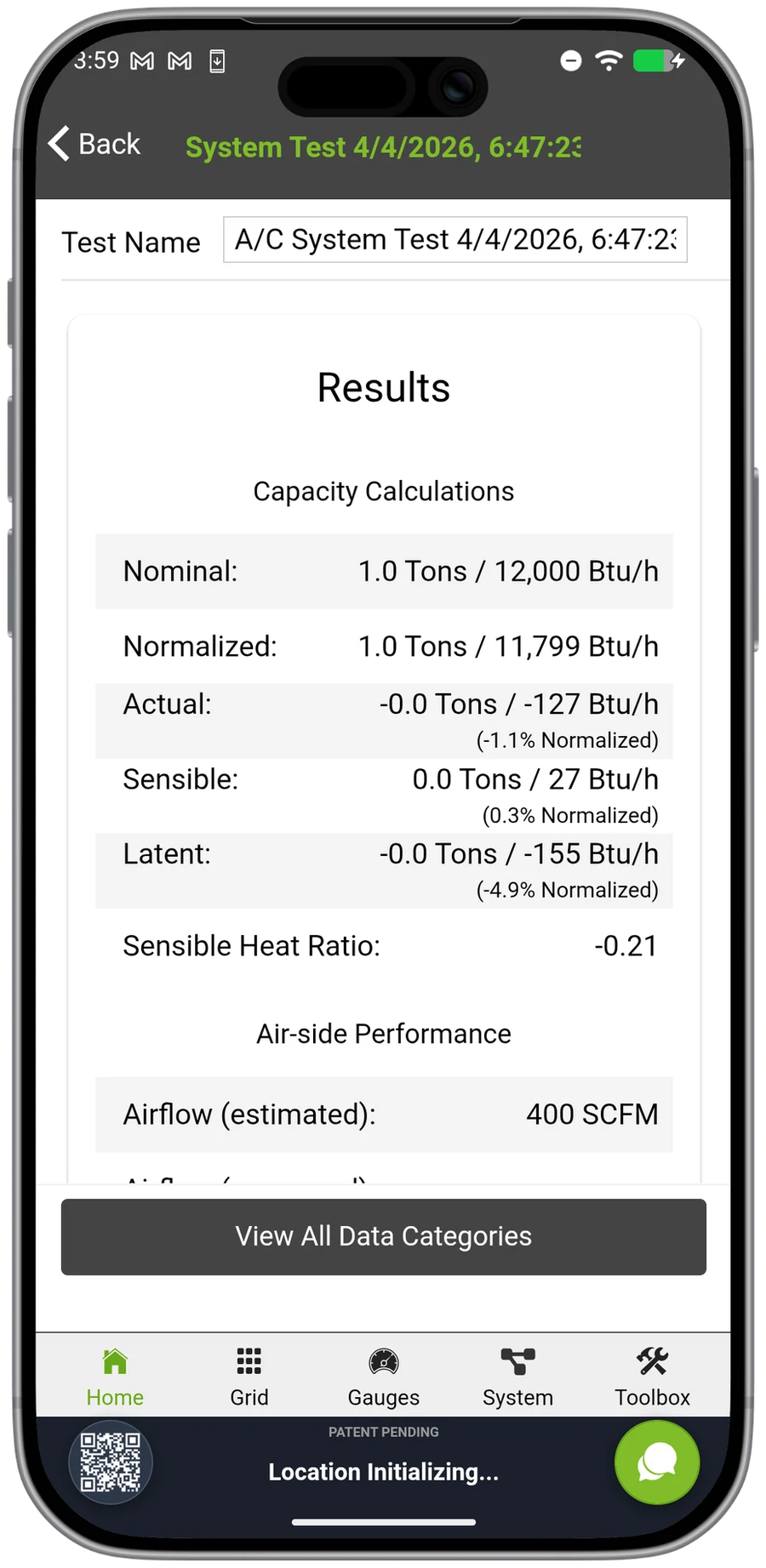
Equipment is rated at fixed AHRI conditions, but you never test at those conditions. measureQuick corrects the live readings to the rating conditions, so the score reflects the equipment itself, corrected for the day's weather. That normalization is the core of the platform, and it is patented. The measurement underneath it is NIST-tested to lab-grade accuracy, at 10x lower cost and 100x simpler deployment than lab instruments.
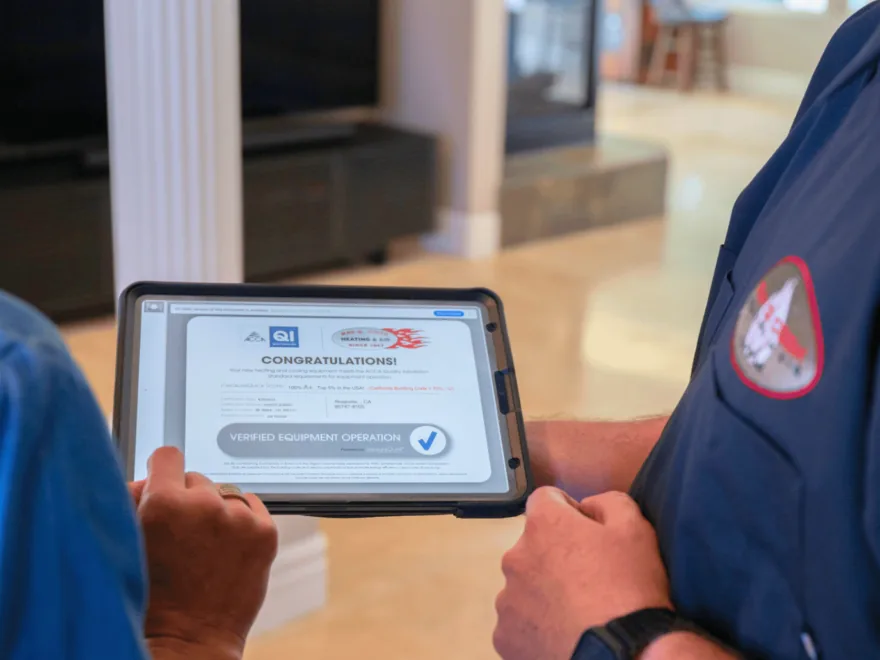
Maps to ACCA QI
A Vitals pass lines up with ACCA Quality Installation criteria. The same measurement that proves the work to the homeowner also documents compliance, with no second workflow.
A baseline you can move
A grade is a baseline the work can move, and the movement is the proof the work was worth paying for. Brandon Payne, a service manager at Ecoplumbers, watched a tech bring a system from an F to a B on a routine clean-check: "to go from an F to a B a customer was happy as, as all get out and has referred many customers to us just based on that one good experience with measureQuick."
The grade also keeps a record. Tracked across annual visits, a system that slips from 85 to 78 turns the maintenance conversation into a data-backed conversation, and a drop on a return visit is the opening to lay out options. Heating scores from before and after October 2, 2026 are calculated differently, so compare like with like.
That record is where the gap between rated and delivered capacity becomes visible. Brynn Cooksey, owner of Air Doctors, uses it on the doorstep: "you're rated at three times, but you're only getting two out... the probes and the tools and the reports actually get to show you the number so you can prove to the customer that you're not getting delivered efficiency that they think they are."
The score in the homeowner's hands
The Vitals score turns a full diagnostic into one number a homeowner can read, in about 20 minutes on site: the number, the measurements behind it, and the findings in plain language. It is often the first time a customer has been shown the health of their own system, and on the v3.6 mQ+ interface a quick test reaches a finished report in under five minutes. Watch how it comes together.
See the HVAC Vitals™ Report for yourself
Download the sample HVAC Vitals™ Report a homeowner receives after a verified diagnostic, and the one-page flyer that explains the score at the kitchen table.
“When using measureQuick's HVAC Vitals Reports, we guarantee that you'll recoup that $49 in a single day from reduced callbacks or increased ticket sizes.”
Questions, answered
What does a Vitals score actually measure?
A complete read takes supply and return air, suction and liquid conditions, and the indoor and outdoor environment, across nine probe channels. Vitals rolls the refrigerant side, the air side, and the system conditions into one 0 to 100 number.
Is the score free, or do I need Premier?
The free plan shows the live readings from your connected probes and where each one stands. The graded 0 to 100 HVAC Vitals™ score and the printed Report you hand the homeowner both come with Premier Services, at $49 per technician per month.
What does a failing score tell me?
A fail names the exact measurement that pulled the number down: charge, airflow, static pressure, or delivered capacity. That turns the grade into a diagnosis the technician can act on and the homeowner can understand.
Can the score be faked by typing in numbers?
No. A meaningful grade requires all nine probe channels reading live, and the ACCA Quality Installation certificate built on the same data requires Bluetooth-measured fields, so a number cannot be hand-typed to pass.
Why is the score age-adjusted?
A fifteen-year-old system is graded against what it can reasonably do today, adjusted for its age. The number stays fair and the homeowner stays trusting.
Does a Vitals pass count for compliance?
A pass lines up with ACCA Quality Installation criteria. The same measurement that proves the work documents the compliance, with no second workflow.
Give every system a vital sign.
Real-time diagnostics on 80+ tools across 17+ brands are free forever. Premier is $49 per user per month.