
Principles, Not Procedures: Rethinking How We Train HVAC Technicians
I posted a video on YouTube over a year ago titled “Stop Trying to Calculate Superheat and Subcooling on Every Job, Do This Instead”:
It's amazing how many negative and or concerning comments that video gets. Here are a few examples:
“So what he's telling everyone is that automating this step means he can hire anyone off the street and pay them less and increase his profit. There is no need for a competent HVAC R technician. You only need a parts changer." - Yourmommashouse770
“Over reliance on apps and technology can lead to a passive approach and problem solving where individuals may forego critical thinking or real-world experience” - Cruzfernandez4554
“What happens when you take a test, and they ask you to calculate the subcooling and superheat manually. They won't be able to” - JohnD-f20
In response, I cannot say it better than Steve Jobs did back in 1983:
“What computer programming does is it captures the underlying principles of an experience, not the experience itself, but the underlying principles of the experience and those principles can enable thousands of different experiences that all follow those laws.
If you will, and the perfect example is the video game. What does the video game do? It follows the laws of gravity of angular momentum, and it sets up this stupid little pong game. But the ball always follows these laws, no two pong games are ever the same and yet every single pawn game follows these underlying principles. “ - Steve Jobs, 1983
measureQuick does just that. It is an application that captures the underlying principles of HVAC. It is a set of underlying principles that follows the laws of refrigeration and air conditioning and airflow.
measureQuick does not capture the experience of fixing an air conditioner itself. It cannot clean a coil or change a capacitor.
measureQuick is simply a tool that allows the technician to work within the confines of the laws and see how the repair impacts the operational outcome.
It’s a visual representation of the system and measurements that communicates the underlying laws and principals visually better than any single calculation ever can.
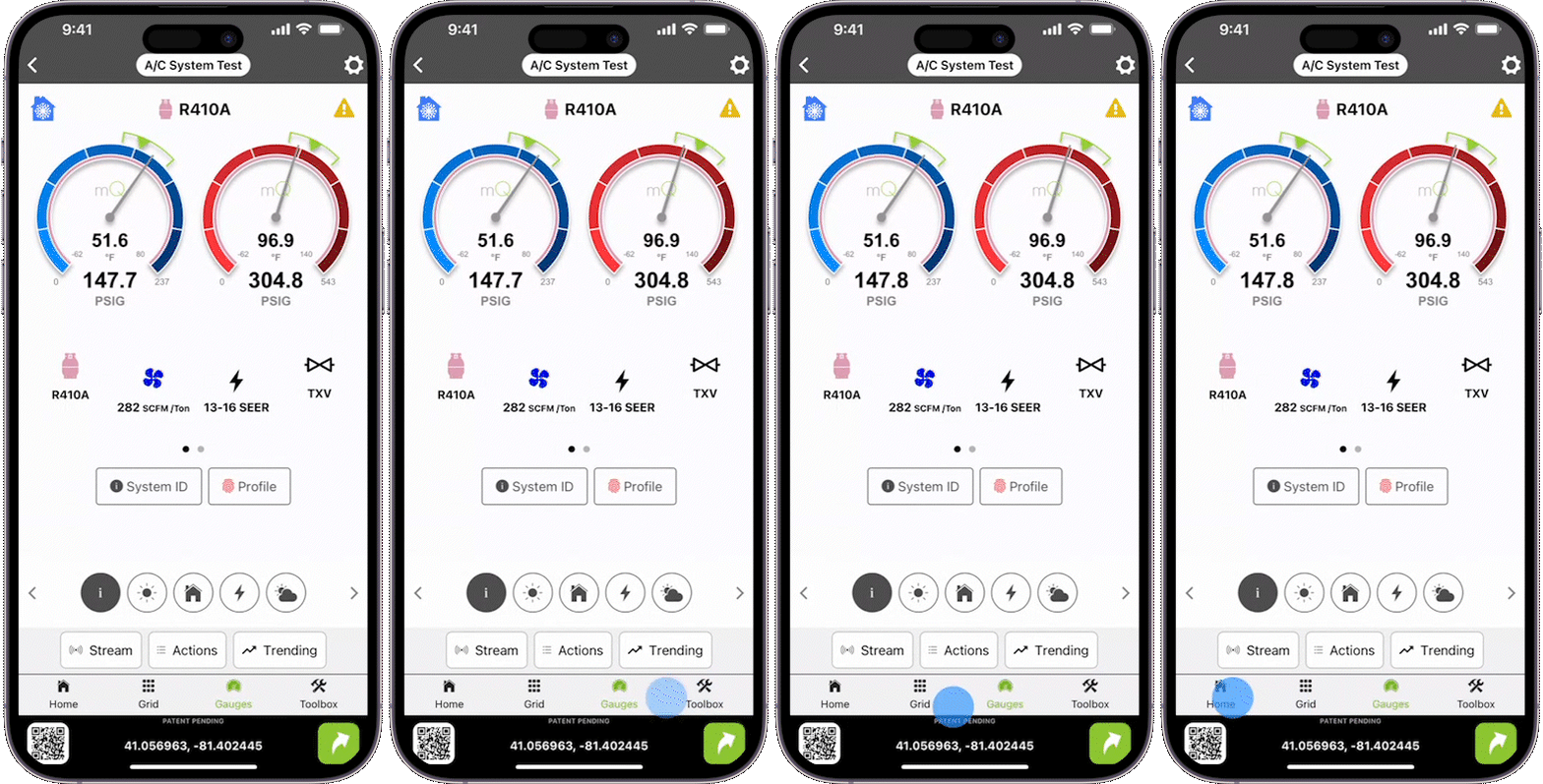
As technicians for the most part we are visual learners just like a sports player. A tennis player does not have to learn the laws is angular momentum and how to calculate how fast the ball will travel and where it will land before they place tennis. A tennis player learns quickly from the experience. If they had to do all the angular geometry calculations when the ball was hit, the ball would land before they picked up their racket.
The same is true with air conditioning and refrigeration. By the time you make the calculations conditions are not the same. The ball has landed, and something is going the opposite direction. Learning the underlying principles and laws without having to focus on calculations provides a huge advantage when it comes to learning our trade.

“You can argue about the content of the model but one thing you can't argue about they will sit there for hours and play that and learn. We've got to get our models better and better and more sophisticated but that is an interactive way of learning that none of us ever had when we were growing up and again thousands of individual experiences, but all based on that one set of underlying principles” - Steve Jobs
Steve had it right. We can argue about how measureQuick works or how it is structured, but what we cannot overlook is that a technician in a training setting will sit there for hours and play and learn.
It is a powerful tool that can be easily transitioned into the field to significantly increase productivity early in a career.