
Proof, not promises.
A homeowner cannot judge HVAC work, so they judge trust. A measureQuick report replaces the handshake with evidence: a branded report carrying the Vitals score, the photos, and the readings, scored against a published standard. The recommendation stops being your opinion and becomes a number a third party can check, and the same record is your alibi when a job gets questioned later.
The trust gap
When the customer cannot see the problem, every recommendation sounds like a sales pitch, and every dispute comes down to your word.
- Recommendations that feel like upselling to a skeptical homeowner
- Disputes over what was actually wrong with the system
- Work that is invisible the moment the panel goes back on
- No record to show the next tech, the warranty desk, or the rebate program
- A warranty claim that turns into your word against the manufacturer's
What you get
A report that proves it
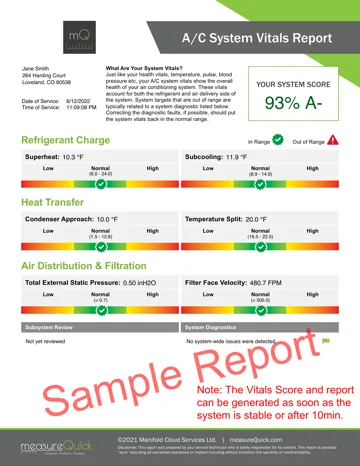
The customer report carries the Vitals score, photos, and plain-language findings under your brand. The proof rides with the recommendation, so the homeowner sees the evidence behind the price.
The measurement is the grade
The score comes from the measurement, so the conversation moves from trust to evidence. Matthew Condron, an HVAC contractor, on what the report does: it "actually takes all of these data points and puts it into something that anybody can read and actually does a customer facing report."
Let them watch it fail
Shoot a clip of the failing part right at the equipment and show the homeowner what you saw. With Premier Services, techs can attach clips of up to 6 minutes to the test record, before and after the work.
The record that settles the dispute
A timestamped test-in is an alibi. When a callback turns into an argument, or a manufacturer questions the install, the original readings tell the story. John Whitehead, co-owner of Honest Heating and Cooling, puts it plainly: "once the measurements are harvested, there's never any room for argument."
Proof the customer keeps
Every job is documented and saved, so the next visit, the warranty desk, or the rebate program starts from the saved record. As contractor Max Wilbanks describes it, the report is "an insurance policy that they got what they paid for."
Proof, measured
A scored measurement stands on its own. measureQuick benchmarks performance non-invasively, and the measurement underneath is NIST-tested to lab-grade accuracy. Jim walks through how the non-invasive test works.
“I use measureQuick because I want to prove to my customers that what I install is the way I promised.”
Questions, answered
What is in the customer report?
The Vitals score, photos, and plain-language findings under your brand, plus any video you attach. The homeowner sees the evidence behind the recommendation.
How do I show a homeowner a problem they cannot see?
Record a clip of the failing part and show it to them on the spot. With Premier Services, techs can attach clips of up to 6 minutes to the test record, before and after the work, so the evidence stays with the job.
What happens when a job gets disputed?
The test-in is timestamped and stored, so when a customer or a manufacturer questions the work, you have the original readings on file. Contractors use that record to settle warranty calls in minutes, because the data shows what the system was doing the day the install was done.
Will customers see a report as a sales pitch?
A measurement scored against a published standard carries its own weight. The number and the photo move the conversation from trust to evidence.
Does it help protect a new-construction install?
Yes. A commissioning record showing the system hit spec is documented proof for the builder and the homeowner, and it protects the warranty if a question comes up later.
What if a program or inspector asks for documentation?
It already exists. The diagnostic you ran is the record, so compliance proof is a byproduct of the work, with no separate paperwork scramble. For a formal third-party certificate, the ACCA Quality Installation path issues VEO and VSP certificates from the same measurements.
Read the proof for yourself
Download the sample HVAC Vitals™ Report and Pro Report and see exactly what a homeowner keeps: the score, the photos, and the findings in plain language.
Prove your next job.
Real-time diagnostics on 80+ tools across 17+ brands are free forever. Premier is $49 per user per month.