
Communicating measureQuick Results to Homeowners
By Adam Mufich, National Comfort Institute (NCI)
The most accurate test in the world is worthless if the homeowner does not understand what you found. Here is how to turn your mQ report into a conversation that earns trust and a decision.
National Comfort Institute has always stressed the importance of not being too technical when explaining system issues to customers. When someone cannot understand the information you're explaining, you quickly lose their attention and their capacity to make an educated decision.
HVAC professionals sometimes struggle to reframe things in a way that their customers can understand. I'm concerned many feel the need to prove their worth by spewing as much technical data as possible. Unfortunately, the only one you end up impressing is yourself. Most people don't have a desire to learn about superheat and subcooling. They just want enough information to guide them to a solution that meets their needs and their budget.
Start With Why, Not the Numbers
For most of us, it has taken years to build an understanding of the measurements and data in an HVAC system. They make sense to us, but not so much to people outside the trade. Think of your mQ report as a conversation tool instead of a data dump. It's common for technicians to say things like, "As you can see, your subcooling is 10 degrees, but the evaporator temperature is low, and by the way the Total External Static Pressure is 0.82 in. w.c., which is not good." No homeowner will have a clue what you just said.
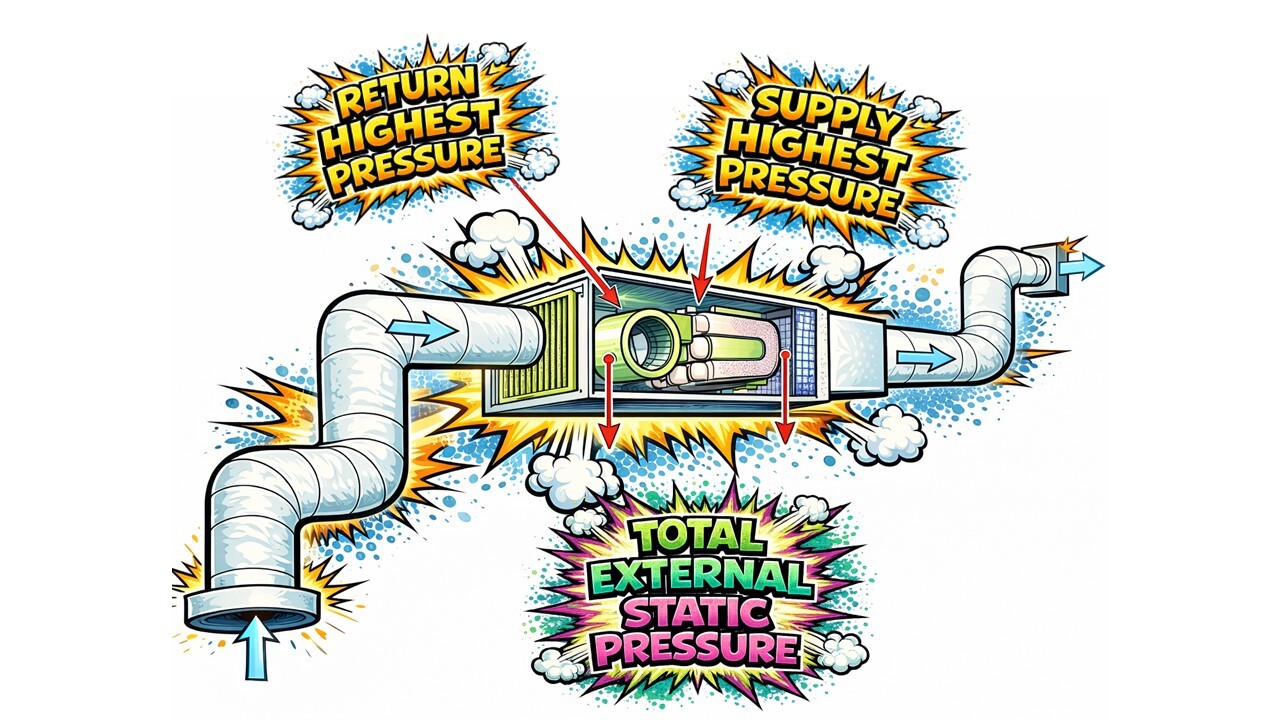
Another option might be: "I tested how well your system is cooling your home. Part of my testing included measuring your furnace blower's ability to move the right amount of airflow. Think of your blower motor like a human heart. If your blood pressure is high, it can cause health issues. I measured your duct pressure, which is like blood pressure, and it's running higher than it normally should. This can create future service issues or even premature failure. The low airflow is causing red flags on the refrigerant side of your system, which impacts your equipment's efficiency."
Same data. Completely different conversation. The second version trades jargon for a picture the customer can hold onto.
Connect Measurements to Symptoms
Several years ago, I listened to a handful of audiobooks on sales, written by David Sandler. One of my takeaways was to use the customer's pain when selling. In this context, it probably sounds like a slimy selling tactic, but hear me out.
I believe most technicians don't think of themselves as salespeople. For years, the whole thought of selling made me cringe. I have always loved the technical aspects of the trade but had a deep hatred for sales. The way I overcame this obstacle was to use measurements and technical data to solve problems.
So how does pain tie into this? If a customer has a comfort complaint, or maybe they're annoyed with how loud their system is, you can relate certain aspects of the report to what annoys them. That's their pain. As an example, the indoor blower motor sounds like a rocket ship and causes them to turn up their TV volume. You can tie this problem to high Total External Static Pressure. Another example is the condensate drain that continually clogs. The customer is tired of paying to unclog it, and there might be a direct connection with undersized or inadequate filtration and/or duct leakage. The bigger the pain point, the more likely they are to spend money addressing that problem.
Focus on solving the issues that matter to the customer, but always communicate the items that they are unaware of.
Low Vitals Score, Now What?
A low vitals score when testing out might cause a technician to hesitate to review the report with the customer. After servicing the equipment, mQ should provide its stamp of approval with an A+ rating, right? Not exactly.
Keep in mind that measureQuick calculates the HVAC Vitals™ score across five different areas, each based on multiple operating data points: refrigerant charge, airflow, static pressure, delivered capacity, and the system conditions it is running in. Some can be improved with small system adjustments, while others require more extensive work. One area, however, cannot be improved at all.
The age of the equipment is not something that can be improved in the field (obviously), but it can negatively affect the vitals score. Communicate the equipment age losses as just that. measureQuick already does some of this work for you, because the score is age-adjusted: a fifteen-year-old system is graded against what it can reasonably do today, not against a brochure from when it was new. Take the opportunity to explain the score and highlight the positive aspects of the report. The equipment could be 20 years old and functioning perfectly. Point out the average life span of equipment so the customer is aware of how their equipment fits into that average. However, avoid using the equipment's age as a scare tactic to sell equipment.
NCI has done performance studies of HVAC systems and found that the average delivered efficiency is around 57%. Keep that in mind when reviewing reports. There are a lot of opportunities to make system improvements, and the vitals score is a third-party verification tool that can help communicate system deficiencies. (For more on why that 57% number matters, see the difference between 57% and 90% delivered capacity.)
Don't Skip the Summary
Most customers will quickly forget the numbers in the report but will remember the conclusion. Take a minute to review the Service Summary page in the report with your customer. Think of this page as the most important points from your service that could help guide them to a decision that would improve their system.
If the equipment has a high vitals score, point out the importance of maintaining a clean air filter and keeping up with equipment maintenance. Doing so should help their system operate efficiently for years to come.
When the equipment is operating with a low vitals score, point out that just because the system is providing cool air, it doesn't necessarily mean it's operating efficiently.
Want to see what your customer sees? Take a look at a full HVAC Vitals™ sample report and notice how the Service Summary page does the heavy lifting in plain language.
On the homeowner's copy, the vitals number carries a letter grade, because a grade needs no translation. As Paul McHugh, a sales manager and trainer at Ray O. Cook, puts it: "with a letter grade, everybody went to school and everybody knows A is good and D and F is bad."
Using Data to Establish Trust
measureQuick gives technicians the ability to validate system performance by using actual measurements instead of just guessing. However, the report's value is not in the data itself. The real value comes from your ability to translate that data into meaningful conversations a homeowner can understand. By using third-party verification and sharpening your communication skills, you will be looked at as a trusted advisor instead of a run-of-the-mill parts changer.
About the Author
Adam Mufich is an instructor, a member of the curriculum development team, and a podcast host for National Comfort Institute (NCI). Adam owned and operated a residential HVAC company in the Chicago suburbs that specialized in High-Performance HVAC™ contracting. If you're an HVAC contractor or technician interested in learning more about NCI's training, contact Adam here. NCI's website is full of free information to help you improve your professionalism and strengthen your company. Visit HVAC Today to read more articles like this or listen to the High-Performance HVAC Podcast.
Keep exploring
- HVAC Vitals™: the residential commissioning score: what the 0 to 100 score measures and how it is earned.
- Getting Started With Static Pressure Diagnostics: Adam's companion piece on the air side.
- ACCA Quality Installation in measureQuick: issue third-party certificates from the field.
- The difference between 57% and 90% delivered capacity: why verification at the system level matters.