
Why Triple Evacuation and Cold Weather Evacuation Don't Work
And How This Evacuation Graph Proves It
Most of us were taught that triple evacuation is the gold standard for drying a system. The logic seemed bulletproof: break the vacuum three times, push in nitrogen, pull it back down. Somehow, the moisture disappears.
To prove the point, we set up a real evaporator coil and line set with a tiny amount of moisture. Here's a real evacuation done on a 27-30°F day with a TruBlue vacuum rig, a Testo 552I pump, and a calibrated BluVac Pro:
- We pulled the system down to 135 microns.
- The system was STILL wet.
- Triple evacuation didn't help.
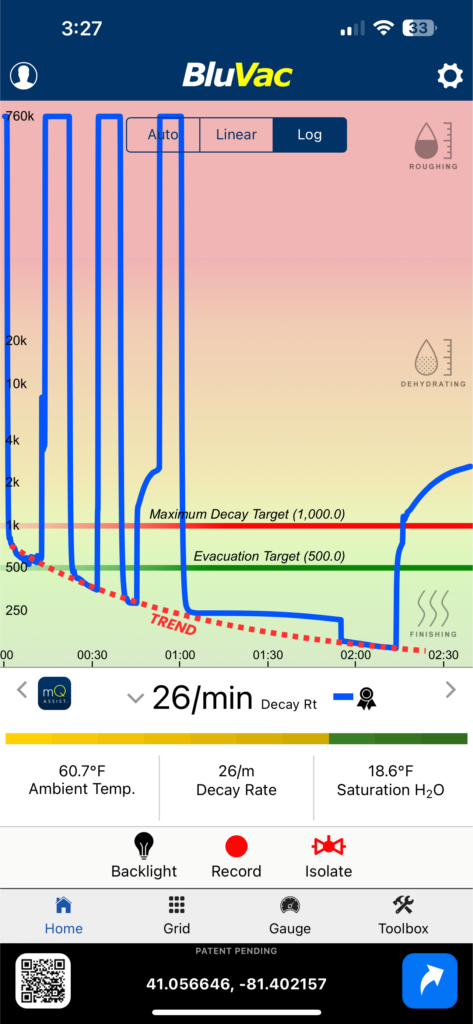
This evacuation graph is a perfect case study in why triple evacuation is outdated, and why hitting a deep vacuum number does NOT mean the system is dry.
1. The Graph Tells the Story: Triple Evac Didn't Change a Thing
Look at the evacuation slopes:
- Every pull follows nearly the exact same slope
- Every decay rises the same way
- The system tails off above 1,000-2,000 microns
- It NEVER stabilizes (flattens out)
If triple evacuation worked, each pull would look significantly deeper, and the isolation would improve. You can see that each time it was pulled back down, the slope at the bottom mirrors that of a long pulldown.
The curves are identical.
That means nitrogen sweeps had almost zero effect on drying.
The limiting factor was TEMPERATURE, not technique.
2. The System Hit 135 Microns, But It Was Still Wet!
This is the part that surprises techs:
A good vacuum rig can overcome the low vapor pressure and force a system down to 135 microns even when moisture is still present.
Deep vacuum alone doesn't prove dryness.
Why? Because the physics of vapor pressure creates a trap that most technicians fall into.
| Condition | Temperature (°F) | Temperature (°C) | Vapor Pressure (Microns) | Vapor Pressure (Pa) |
| Initial State | 32°F | 0°C | ~4,584 | 611 |
| Cold Ambient | 28°F | -2.2°C | ~3,883 | 517 |
| Sublimation Cooled | -20°F | -29°C | ~300 | 40 |
| Deep Freeze | -40°F | -40°C | ~96 | 12 |
3. Vacuum Pumps Don't "Pull" Moisture Out. Pressure Pushes It.
This is the physics most techs never hear:
- Vacuum pumps create a low-pressure zone
- The system must PUSH vapor toward the pump
- In cold systems, frozen moisture produces almost no push

A vacuum pump does not reach into the copper tubing and pull molecules out. In strict physical terms, "suction" does not exist. A vacuum pump merely creates a mechanical void at its inlet. The evacuation of a refrigeration system is entirely dependent on kinetic molecular theory, which describes gas as a collection of particles in constant, chaotic motion.
The vapor pressure of ice at 28°F is approximately 3,800 microns.¹ But here's the trap: as sublimation cools the ice further, that pressure collapses. At -40°F (easily reached during deep evacuation), vapor pressure drops to just 96 microns.¹

That's why a high-performance vacuum rig can pull the system to 135 microns while ice remains inside. The ice has gone dormant. Its vapor pressure has collapsed below what the gauge is reading. The pump wins the tug-of-war not because the system is dry, but because the ice can't push hard enough to register.
4. The Truth Only Appears When You Isolate the Pump (The Decay Test)
When you close the isolation valve:
- The pump is no longer "winning"
- The system's internal vapor pressure builds
- Ice begins to warm and starts sublimating faster
- The gauge shows the REAL condition of the system
In this case?
- Pressure shot past 1,000 microns
- Never stabilized (flattened out)
- Proved the system was still wet
Even after HOURS of evacuation.

ASHRAE Standard 147 and Guideline 6 address this directly: vacuum decay testing, not the absolute micron reading, is the verification method for dehydration.² The industry standard requires pressure to hold below 500 microns for a minimum of 10 minutes with the pump isolated.³
As I've discussed before in identifying true leaks in a vacuum, distinguishing between moisture and actual leaks is critical for proper diagnosis. The decay curve tells you which you're dealing with. A leak produces a linear rise toward atmospheric pressure. Moisture produces a rapid rise that plateaus at the vapor pressure of water at the coldest point in the system.
5. Why Triple Evacuation Was Never Designed for Today's Systems
Triple evacuation was developed for:
- Single-stage pumps with roughly 300 micron ultimate vacuum
- 1/4" hoses that choked in molecular flow⁴
- Compound gauges that couldn't verify below 200 microns
- Dirtier systems before nitrogen-swept copper became standard
Modern reality:
- Two-stage pumps rated at 25 microns
- High-flow vacuum rigs (TruBlu, etc.) that maintain conductance⁵
- Digital micron gauges with decay graphing
- Nitrogen that isn't perfectly dry (3-5 ppm moisture in most cylinders)⁶
But the real reason triple evac fails in cold weather is simple:
- Moisture is frozen, and nitrogen cannot melt or remove ice.
- Cold systems dry by sublimation, not boiling, which is extremely slow.
You cannot sweep a solid. Blowing dry gas over an ice cube in a copper pipe is incredibly inefficient compared to sublimating it. The nitrogen does not transfer enough heat to melt the ice rapidly, nor does it mechanically dislodge it.
Sublimation is the direct transition from solid to vapor, skipping the liquid phase. This process requires a massive input of energy: the latent heat of sublimation. For water ice, that's approximately 2.8 MJ/kg.⁷ In a vacuum, there is no convective heat transfer from the air (because there is no air). The only source of heat is conduction from the copper tubing and the remaining internal energy of the ice itself.
6. What Actually Works Better Than Triple Evacuation

To dry a system, especially in cold weather, you need:
ONE long, deep pull (<200 microns)
Not three shallow ones.
TIME
Sublimation has no shortcuts.
HEAT (even a little helps)
Warm metal = faster moisture release. As we've covered in cold weather commissioning, adding heat to the refrigerant circuit increases molecular energy and vapor pressure. Use heat guns, heated blankets, or run the furnace if the lineset passes through a conditioned plenum.⁸
A PROPER DECAY TEST
Only isolation tells you if moisture is gone.
7. The Big Lesson from This Graph
Hitting 135 microns shows the ability of the vacuum rig. The decay test shows the condition of the system.
- The TruBlu vacuum rig could easily overpower the tiny vapor pressure generated by frozen moisture.
- The decay test exposed that the system was still wet.
- Triple evacuation provided no measurable improvement.
This is why modern evacuation best practice has changed:
- Triple evacuation is outdated
- Nitrogen sweeps don't dry frozen moisture
- Deep vacuum ≠ dry system
- The decay curve tells the truth
- One long, deep evacuation + heat + a verified decay curve beats triple evac every time
Digital graphing tools, like measureQuick's evacuation tracking, make this visible. You're not watching a number. You're watching a curve. A wet system produces a characteristic rise-and-plateau pattern that's unmistakable once you've seen it.
The graph doesn't lie. The question is whether you're reading it.
References
- Vapor Pressure of Ice, LyoTechnology, Technical Reference Chart, 2015
- ANSI/ASHRAE Addendum c to ANSI/ASHRAE Standard 147-2019, ASHRAE, Standards and Guidelines, 2022
- Heat Pump Quality Installation and Commissioning, Building America Solution Center, Pacific Northwest National Laboratory, 2024
- Fundamentals of Vacuum Technology, Leybold, MMRC Caltech, 2016
- TruBlu Evacuation Tools: Steps to a Proper Evacuation, HVAC Tools Australia, 2023
- Nitrogen Purity Grades for Different Industrial Applications, NiGen International, Technical Specifications, 2024
- Temperature dependence of the sublimation rate of water ice, ResearchGate, Journal of Physical Chemistry, 2014
- Review of Vacuum for Service Engineers, Revised by Jim Bergmann & Bryan Orr, Technical Manual, 2023
- Residential HVAC Installation Practices: Review of Research Findings, U.S. Department of Energy, EERE Buildings, 2022
- Optimizing Residential HVAC Systems: Evaluating How the Usage of Smart Diagnostic Tools for Quality Installation and Commissioning Impacts System Performance, National Renewable Energy Laboratory, U.S. Department of Energy, 2024