
2025 Heat Pump Summit: What Contractors Don't Know About Winter Installs
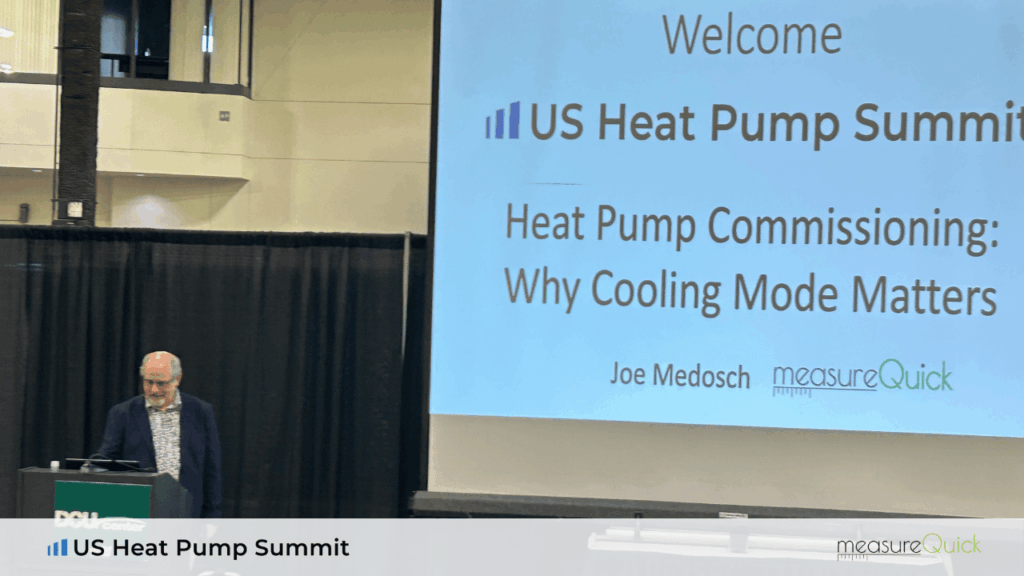
Worcester, MA got cold during the 2025 Heat Pump Summit. Which was perfect timing, because Joe Medosch was on stage explaining why you can't properly commission a heat pump when it's freezing outside.
Joe, our Director of Training, teamed up with Jim Bergmann and Ben Chouinard for what became the most talked-about session of the Summit. While Jim and Ben couldn't make it in person, their insights shaped Joe's presentation on cold weather commissioning, a topic that's been giving contractors headaches since heat pumps started moving north.
Nobody Wants to Talk About This
Manufacturers may say "charge & commission in cooling mode!" But won’t tell you this outright: if it’s below 30°F, you probably shouldn’t be starting up that heat pump at all. Not because the equipment can't handle it, but because you literally cannot get the moisture out of the system when it's that cold.
Here's how moisture infiltrates before you even start: When outdoor air is cold, especially below freezing, an open line set becomes a moisture magnet. The copper cools to outdoor temperature, and any humid indoor air that migrates into the tubing instantly condenses. In the coldest sections, it can even freeze inside the lines. This problem is exponentially worse when line sets run up the outside of a home with significant exposed area versus minimal outdoor exposure through a wall penetration.
That moisture doesn't just evaporate later; it stays trapped and becomes a significant contaminant. During startup or evacuation, this residual moisture prolongs the vacuum, slows dehydration, and if not completely removed, compromises oil integrity, TXV operation, and system reliability. The solution? Multiple filter dryers and extended evacuation times, but even these measures have limits in extreme cold.
Joe put it bluntly during his session: "The issues are not from manufacturers, they are science." When moisture freezes in your lines, it doesn't evaporate anymore, it sublimates. For those who skipped chemistry class, that's when ice turns directly into vapor. Sounds simple enough, except this process that normally takes minutes suddenly takes hours. Sometimes days.
2025-11-13 mQ US Heat Pump Summit Final Joe MedoschDownloadJim agrees:
"This is actually an Achilles heel of heat pumps. You don't want to service a heat pump in the winter."
Strong words from someone who's spent decades perfecting heat pump commissioning. As Jim explains in our recent article on cold weather evacuations, the science behind moisture removal at low temperatures creates challenges that can't be overcome with willpower alone.
The $2.5 Billion Problem
According to data Joe shared from NIST studies, we're wasting $2.5 billion annually on poorly commissioned HVAC systems. Not broken systems. Not old systems. Systems that were never set up right from day one.
The culprits are predictable: duct leakage, wrong refrigerant charge, undersized ducts causing low airflow. But here's what caught people's attention, in Houston, just lowering the thermostat by 2°F increases annual energy use by 20%. And it gets worse the more you adjust it. The relationship isn't linear; it's exponential dysfunction.
Enter the Charging Blanket
Joe spent considerable time on what he considers the most underutilized tool in cold weather commissioning: the charging blanket (or charging jacket, or turkey blind if you're Mike from up north, yes, that apparently works too).
Of course, this isn't new technology - Fieldpiece has had one for years. AccuTools makes them. But almost nobody knows they can use these to get accurate subcooling measurements between 35°F and 65°F. The device recirculates warm discharge air back through the condenser, tricking it into thinking it's a balmy 70°F outside.
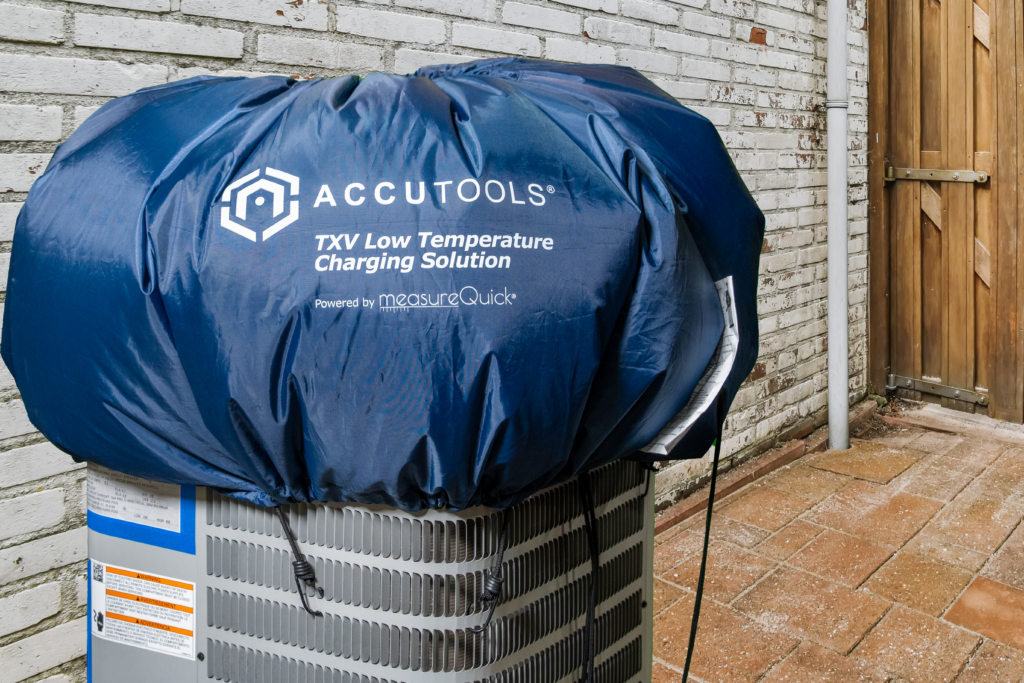
Without getting too deep into the physics (though Joe certainly did), you need about 160 pounds of pressure differential across your metering device for the TXV to actually control. No differential? Your valve stays wide open, acting like a fixed orifice. That's when callbacks start.
The measureQuick platform now automates these calculations for R-410A, R-454B, and R-32, because doing the math manually when it's 35°F and windy is nobody's idea of fun. The AccuTools Charge Assist Device (charging jacket) works on both TXV and fixed orifice metering devices, making it a universal solution for cold weather commissioning. Combined with BluVac's advanced decay testing capabilities, technicians can ensure both proper charging and complete moisture removal.
The Uncomfortable Truth About Winter Installs
During the Summit's business track, several contractors pushed back on Joe's recommendation to delay commissioning in extreme cold. "Customers need heat NOW," was the common refrain. "We can't just walk away."
Joe's response was pragmatic: Run the backup heat.
Yes, it'll cost the customer a few hundred dollars extra in electricity, which many heat pump systems will already be using depending on the balance point that was set. But compare that to the thousands they'll spend when that compressor fails prematurely because you couldn't evacuate properly. When moisture turns to acid in the system, when copper starts plating the compressor bearings, that's not a callback, that's a replacement.
Jim's been even more direct in our internal discussions:
"Can you perform surgery on the side of the road in an ambulance? Yeah, if you absolutely have to. But would you want to?"
This philosophy extends beyond just charging. As we discussed at last year's NCI High Performance Summit, the industry needs to shift toward performance-based contracting where proving your work matters more than completing it quickly.
Where We Go From Here
The Summit reinforced this critical fact, HVAC equipment has evolved faster than our installation practices. Heat pumps work great in cold climates, but only if we commission them properly (which might mean waiting for the right conditions).
For contractors ready to embrace this reality, we've integrated ACCA Quality Installation standards directly into measureQuick, allowing you to provide third-party verified certificates that prove proper commissioning, even when that commissioning happens during a spring follow-up visit.
The 2025 Heat Pump Summit drew, as Joe noted, "one of the greatest gatherings of presenters and trainers" he's seen. But more importantly, it showed an industry ready to stop guessing and start proving performance, even if that means telling customers to wait for warmer weather.


Ready to master cold weather commissioning? Check out our upcoming training events or explore our comprehensive commissioning solutions.